
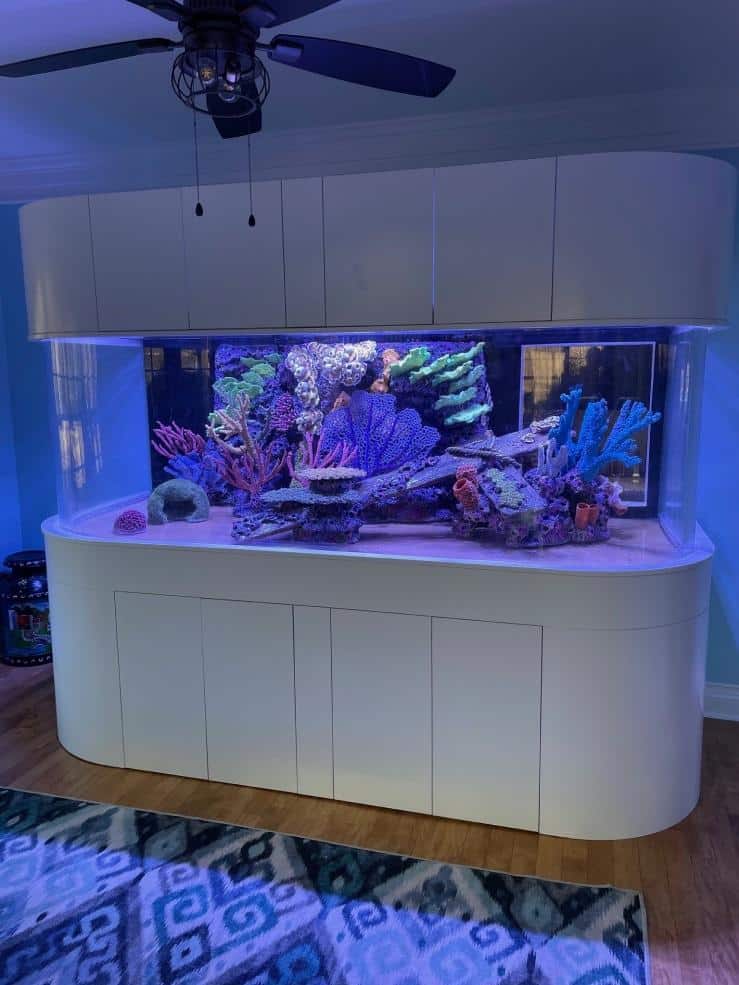
Corals, invertebrates and marine fish all depend on stable salt levels. Reef tank salinity is one of the first numbers we check on every saltwater maintenance visit, because even small swings can stress livestock. Here’s what salinity to aim for, how to measure it accurately, and how to keep it steady week after week.
Key Takeaways
- Natural seawater averages about 35 parts per thousand of salt.
- Many reef keepers aim for a specific gravity of about 1.025 to 1.026.
- Stability matters more than hitting one exact number.
- Evaporation raises salinity, so top off with fresh water, not saltwater.
- Make corrections slowly over several days.
What Salinity Should a Reef Tank Be?
Most reef aquariums are kept close to natural seawater. According to NOAA, the ocean’s average salinity is about 35 parts per thousand. In the hobby, that’s commonly expressed as a specific gravity of roughly 1.025 to 1.026, and many reef keepers target that range.
Fish-only saltwater tanks are sometimes kept a little lower, but reef tanks with corals and invertebrates do best close to natural seawater. Whatever level you choose, the goal is to keep it consistent.
Specific Gravity vs Parts Per Thousand
You’ll see salinity written two ways:
- Specific gravity (SG): compares the density of your tank water to pure water. Reef targets usually read around 1.025 to 1.026.
- Parts per thousand (ppt): the amount of salt per thousand parts of water. Natural seawater is about 35 ppt.
Both describe the same thing. Most test tools show one or both, so pick one scale and stick with it so your readings are easy to compare over time.
How to Measure Salinity
Accurate readings start with the right tool:
- Refractometers are a popular choice for reef tanks. Calibrate them regularly with a calibration fluid, not tap water.
- Digital salinity meters give fast readings and also need regular calibration.
- Swing-arm hydrometers are inexpensive but less precise, which makes them a weaker fit for reef tanks.
Test at the same time of day, and after topping off, so you’re comparing like with like.
What Makes Salinity Swing?
The most common causes are simple:
- Evaporation: water evaporates but salt stays behind, so salinity rises.
- Topping off with saltwater: adding salt mix instead of fresh water for evaporation pushes salinity up.
- Water changes with poorly mixed water: new saltwater that wasn’t tested can raise or lower the level.
- Salt creep and splashing: salt that dries on lids and equipment slowly leaves the system.
Warm months can increase evaporation, so check salinity more often in summer.
Mixing Saltwater for Water Changes
Many salinity problems start with the replacement water, so it pays to mix it carefully:
- Start with purified water, such as RO/DI water, so you aren’t adding unwanted minerals or nutrients.
- Mix the salt in a clean container with a small pump or powerhead to keep the water moving.
- Heat the water to match your tank’s temperature.
- Let it mix fully, often several hours or overnight, before testing.
- Test salinity and adjust with more salt or fresh water until it matches your tank.
Keeping a dedicated container for mixing saltwater, and labeling it so it’s never used for anything else, makes this routine faster and safer. Matching both temperature and salinity is what keeps a water change from becoming a stressful event for corals and fish.
How to Correct Salinity Safely
If salinity has drifted, bring it back gradually. Sudden changes can stress corals and invertebrates more than the original problem.
- Confirm the reading with a freshly calibrated tool.
- If salinity is high, replace a small amount of tank water with fresh, purified water.
- If salinity is low, replace a small amount of tank water with saltwater mixed slightly higher than your target.
- Spread the correction over several days and retest each day.
For tanks on one of our saltwater aquarium service plans, salinity is tested on every visit, and our reef tank maintenance guide explains what else goes into keeping a reef stable.
Frequently Asked Questions
What is the ideal salinity for a reef tank?
Many reef keepers aim for a specific gravity of about 1.025 to 1.026, close to natural seawater at about 35 parts per thousand.
How often should I test reef tank salinity?
Testing a few times a week is a good habit, and more often in summer when evaporation increases.
Why does my reef tank salinity keep going up?
Usually because of evaporation. Top off with fresh, purified water rather than saltwater.
How fast can I change salinity?
Slowly. Spread corrections over several days to avoid stressing your livestock.
Keep Your Reef Stable With Armco Aquatics
Armco Aquatics designs, installs and maintains reef aquariums for homes and businesses across Delaware, Pennsylvania, New Jersey and Maryland, and we stock livestock for saltwater and reef systems. Call us at 302.655.1150 or contact Armco Aquatics to schedule a consultation or a visit to our showroom.
Leave a Reply